
A claims QA lead already knows the problem. In July 2026 Claims Pages put it in one line: "fraudulent evidence is becoming more difficult to detect during routine claim reviews." Documents and images that once showed obvious signs of manipulation can now appear authentic enough to pass an initial visual inspection.
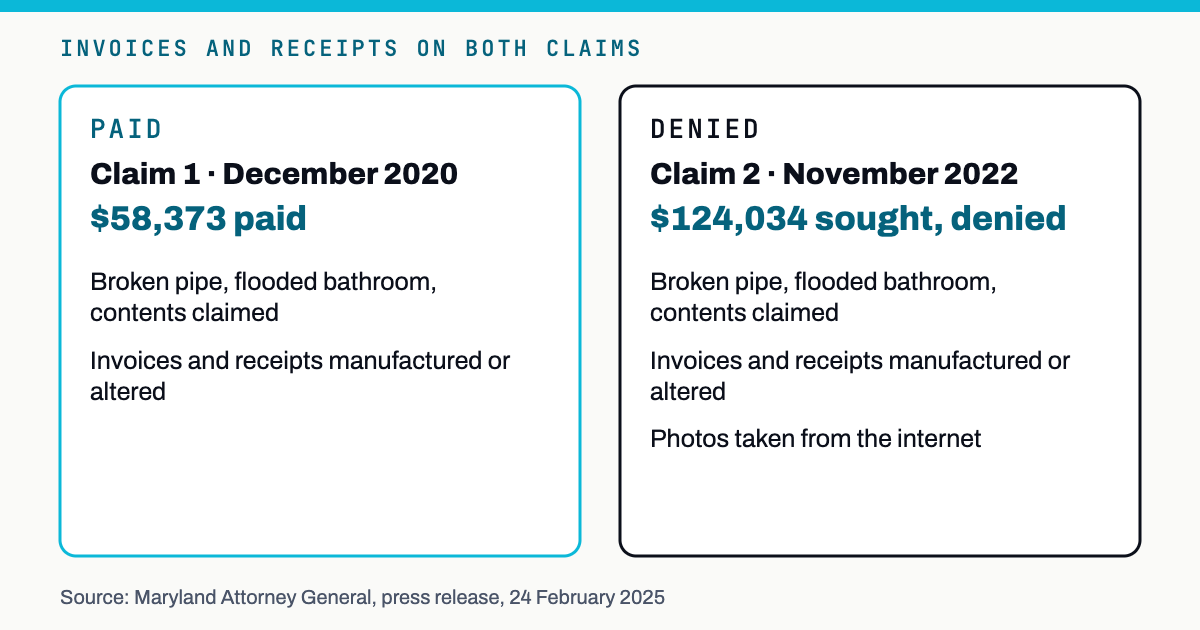
One public insurance fraud case shows what two files can look like. It is not about AI. The release describes manufactured or altered invoices and receipts, and photos taken from the internet.
The insurance fraud case, as the Maryland Attorney General tells it
A Maryland woman made two renter's claims to her insurer: one in December 2020 and one in November 2022. Each described a broken pipe that flooded a bathroom and damaged furniture, electronics, clothing and jewelry. The invoices and receipts sent with both claims had been manufactured or altered. In denying the second claim, the carrier also found that the damage photos were taken from the internet.
The carrier paid $58,373 on the first claim. It denied the second, which sought $124,034. In the Attorney General's account, the carrier denied the second claim when it learned that she had never reported any broken water pipes or water damage to her landlord, that the invoices and receipts had been manufactured or altered, and that the photos came from the internet. The release does not say which finding decided the denial, and it does not say why the first claim passed.
She pleaded guilty in October 2024 to two counts of felony insurance fraud. On 20 February 2025 she was sentenced to five years, all but 45 days suspended, five years of supervised probation and $58,373 in restitution.
Four questions the case answers
A claims desk asks ten questions of a file (the ten questions are in the image below). The public record of this case answers four of them.
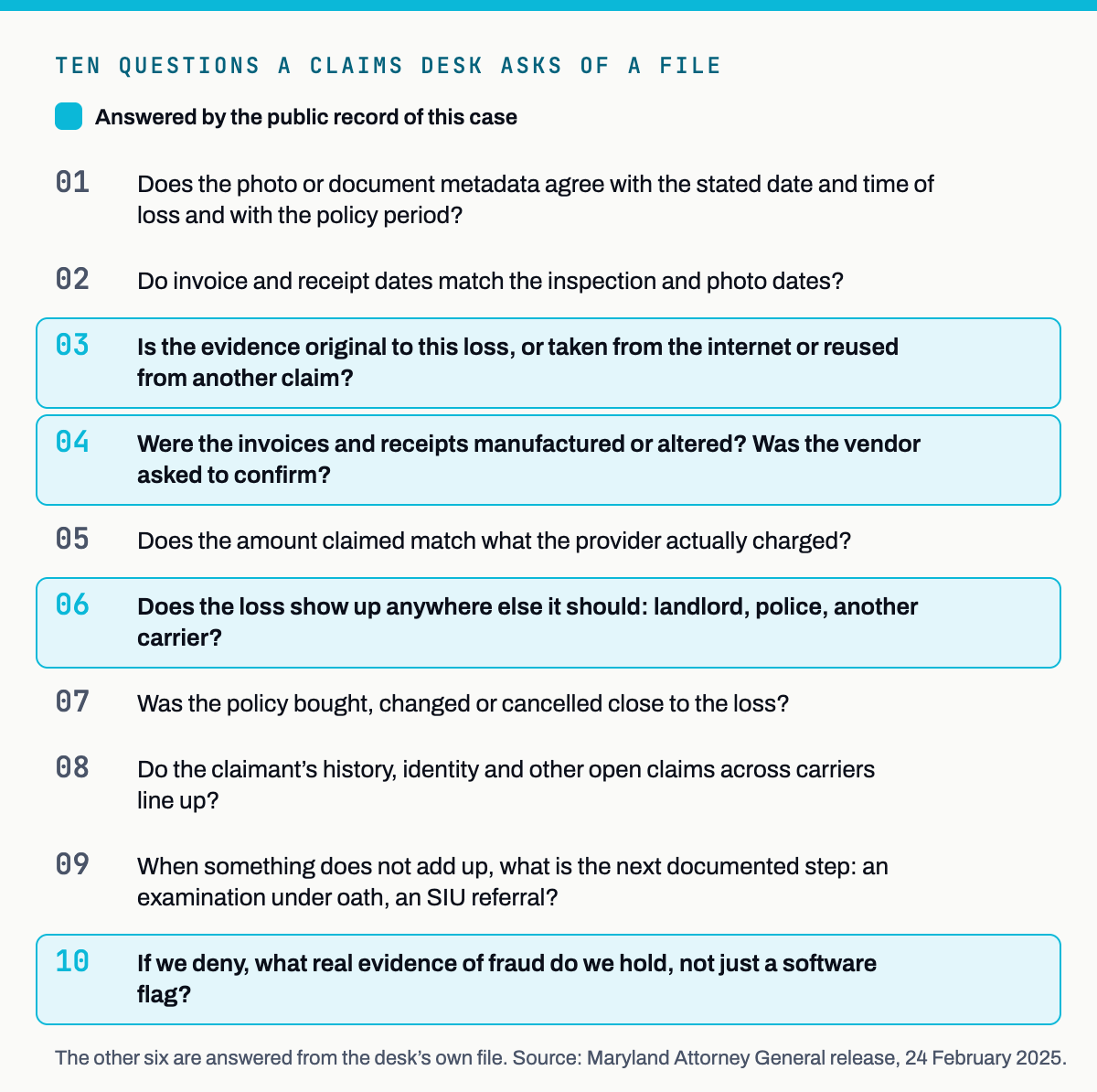
- Is the evidence original to this loss, or taken from the internet or reused? The damage photos were taken from the internet.
- Were the invoices and receipts manufactured or altered? They were, in both claims. The release does not say whether vendors were asked to confirm.
- Does the loss show up anywhere else it should? It did not: she had never reported a broken pipe or water damage to her landlord. That is one of the three findings the release gives for the denial.
- What real evidence of fraud do we hold? The release lists altered invoices and receipts, photos from the internet and no report of a pipe to the landlord. Claims Journal (15 May 2026) puts the general point this way: when denying a claim, professionals must point to real evidence of fraud and not just a software flag.
The other six questions, on metadata, dates, amounts, policy timing, claim history and next steps, are for the desk's own file. The release does not answer them. They are in the image above.
What the wider numbers say
The case is old-style fraud with documents and photos. The figures below are why the same questions matter more now that images are easier to make.
Mentions of AI in questionable claims rose more than 1,400% between 2025 and mid-2026, according to the National Insurance Crime Bureau as reported by Insurance Business and Claims Pages on 17 November 2026. NICB's report is not public, so we rely on those two reports. The figure counts references to AI in questionable claims, not confirmed AI fraud.
66% of insurers say digital media fraud goes undetected often or very often across the industry, in a Verisk study published in March 2026 of 1,000 consumers and 300 claims professionals and commissioned by Verisk. It is a stated belief, not a measured rate.
Treat both as reasons to look, not as rates for your book.
Key takeaways
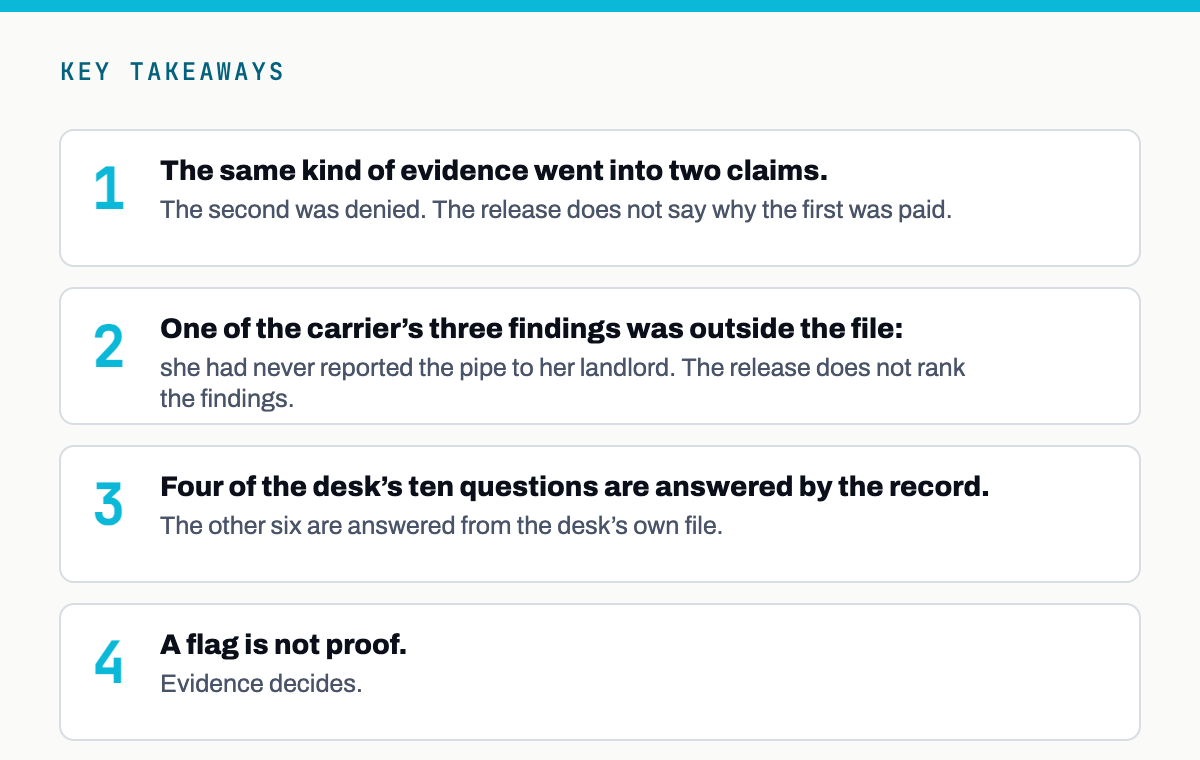
- The same kind of evidence went into two claims. The second was denied. The release does not say why the first was paid.
- One of the carrier's three findings was outside the file: she had never reported the pipe to her landlord. The release does not rank the findings.
- Four of the desk's ten questions are answered by the record. The other six are answered from the desk's own file.
- A flag is not proof. Evidence decides.
Where Ceertia fits
The questions above are the kind of list Ceertia works from.
Ceertia checks each claim file against a list of plain-language questions written for your use case, answers every question that applies to the file, and logs every change made through the application with the user, date and IP address.
Checks outside the file, such as calling the landlord or the vendor, stay with your reviewer.
Ceertia · Evidence-based compliance verification
Frequently asked questions
What happened in the Maryland insurance fraud case?
A Maryland woman made two renter's claims, in December 2020 and November 2022, each for a flooded bathroom. The invoices and receipts of both claims had been manufactured or altered; the carrier also found that the damage photos were taken from the internet. The carrier paid $58,373 on the first and denied the second, which sought $124,034.
Why was the second claim denied?
The Attorney General's account gives three findings: she had never reported broken pipes or water damage to her landlord, the invoices and receipts had been manufactured or altered, and the photos came from the internet. The release does not say which finding decided the denial or why the first claim passed.
Is this an AI fraud case?
No. The release describes manufactured or altered invoices and receipts and photos taken from the internet. It does not describe the documents or photos as AI-generated.
Which questions does the public record answer for a claims desk?
Four of ten: is the evidence original to this loss, were the invoices and receipts manufactured or altered, does the loss show up anywhere else it should, and what real evidence of fraud do we hold. The other six are for the desk's own file.
Is a fraud flag enough to deny a claim?
Claims Journal (15 May 2026) puts it this way: when denying a claim, professionals must point to real evidence of fraud and not just a software flag.
Sources
- Maryland Office of the Attorney General, press release, 24 February 2025 (the insurer named there is USAA).
- Claims Pages, 23 July 2026 and 17 November 2026.
- Insurance Business, 17 November 2026.
- Verisk, news release, 17 March 2026 (study commissioned by Verisk).
- Claims Journal, 15 May 2026.
- Insurance Journal, 24 March 2023 and 26 November 2024.